

Commercial waste management is no longer defined solely by tonnage. Success is now measured through operational efficiency, cost control, and verifiable sustainability. There are vital KPIs businesses should track, using the advanced tools that enable real-time data, and the shifting ESG requirements shaping reporting. By focusing on these metrics, companies can move from reactive hauling to proactive resource management.
For years, a commercial waste service was viewed as a hidden utility—something that happened in the alleyway, away from the boardroom. You paid the bill and the trash disappeared. However, as global supply chains face scrutiny, that hands-off approach is disappearing. In our experience, the most successful organizations stop treating waste as an inevitable expense and start treating it as a data-rich resource.
Managing waste today requires balancing environmental stewardship with the bottom line. It is about more than just going green, it is about optimizing every bin lift. That’s why we feel that a robust Key Performance Indicator (KPI) framework is the only way to move toward true operational excellence. By auditing the composition of your waste stream, businesses can identify specific materials that are being misplaced and implement targeted reduction or recycling initiatives.
Understanding Waste Management KPIs
Waste management KPIs are specific metrics used to evaluate the effectiveness and cost-efficiency of a waste program. Good measurement involves data that is accurate, timely, and actionable. These metrics matter because they provide the transparency needed for regulatory compliance, service quality assurance, and data-driven decision-making that directly impacts a company’s ESG standing.
At its core, a KPI is a compass. Without it, you are simply guessing at whether your diversion programs work. In our experience, companies struggle because they lack a baseline. You cannot improve what you do not measure. By establishing clear KPIs, you create a common language between facility managers, sustainability teams, and haulers. This alignment allows for true optimization, ensuring you aren’t just meeting the minimum requirements but are actually leading your industry.
Types And Categories Of Waste Management KPIs
To manage a program effectively, KPIs should be organized into distinct categories: Operational, Financial, Environmental, and Safety/Compliance. This allows different departments to focus on relevant goals. Whether it is a CFO looking at cost-per-ton or a Sustainability Director tracking carbon offsets, these categories ensure every facet of the waste stream is under meaningful scrutiny.
Here at RTS, we know that no single metric tells the whole story. A program might have a high recycling rate but be over-budget due to inefficient schedules. By segmenting data, you can diagnose specific pain points.
Operational Efficiency KPIs
Beyond simple pickup schedules, operational efficiency is measured by how well your infrastructure prevents waste before it happens. Key metrics include:
- Contamination Rate (%): The percentage of non-recyclable materials found in recycling streams. High contamination leads to wish-cycling fines and rejected loads.
- Right-Sizing Ratio: The delta between your contracted container capacity and actual volume used.
- Diversion Rate Formula: This is the baseline for any sustainability program:
Diversion Rate = [(Weight of Recyclables + Compost) / Total Waste Weight] x 100
Financial and Economic Performance KPIs
To move waste from a sunk cost to a managed line item, CFOs should track:
- Cost per Diverted Ton: Compare the total cost of recycling/composting against the cost of landfilling (including tipping fees).
- Overage and Contamination Fees as % of Total Spend: This identifies leakage in the budget caused by poor on-site sorting or inefficient scheduling.
- Revenue Recovery: Tracking the market value of commodities like OCC (Old Corrugated Cardboard) or LDPE plastics to offset hauling costs.
Environmental and Sustainability KPIs
These metrics populate your ESG reports, including diversion rates, greenhouse gas emissions from transport, and total volume of materials returned to the circular economy.
Safety and Compliance KPIs
Tracking incidents, spillages, and adherence to mandates—like organic waste bans—is essential to protecting your brand and avoiding fines.
Customer Service and Satisfaction Metrics
In a commercial setting, customers are often building occupants and on-site operations teams. Tracking KPIs such as missed pickups, service request resolution time, and response times helps ensure waste services support a clean, safe, and disruption-free environment.
Essential KPIs To Track In Commercial Waste Management
While dozens of metrics exist, most successful commercial programs rely on a core set: volume and diversion rates, collection reliability, spend-per-ton, and container utilization. These essentials provide a holistic view of program health. They serve as the foundation for operational performance while providing the verified data necessary for modern ESG reporting and stakeholder transparency.
| KPI Name | Category | Unit | Business Goal |
| Diversion Rate | Environmental | % | Landfill reduction |
| Contamination Rate | Operational | % | Fine avoidance |
| Cost per Ton | Financial | $/Ton | Budget optimization |
| Fill Level | Utilization | % | Service right-sizing |
If you are just starting, master the essentials first. These metrics represent the primary levers you can pull to effect change in your organization.
Waste Volume, Diversion, and Recycling Rates
The fundamental metric is the diversion rate: the percentage of waste diverted from landfills. According to the EPA, the national recycling rate in the US is around 32%, yet many commercial entities can reach much higher. Tracking total volume versus diverted volume shows the direct impact of your infrastructure.
Collection Reliability and Service Performance Metrics
A missed pickup can lead to health hazards, which is why Missed Pickups per 1000 Stops should be a standard metric. If your hauler isn’t hitting their windows, your operational flow is disrupted.
Cost, Spend, and Savings KPIs
You should track Total Cost of Waste Management and Revenue from Recyclables. In some markets, cardboard can be a revenue generator. A waste management consultant can often identify where hidden revenues are being lost to hauling fees.
Asset and Container Utilization Metrics
Container utilization is the most overlooked lever for cost reduction. If your containers are consistently collected at 50% capacity, you are effectively paying a 100% markup on your hauling.
- Average Fill Level at Collection: Target >80% for maximum efficiency.
- Service Frequency Accuracy: Comparing scheduled vs. actual pickups to identify ghost services or missed opportunities for consolidation.
Methods And Tools For KPI Measurement
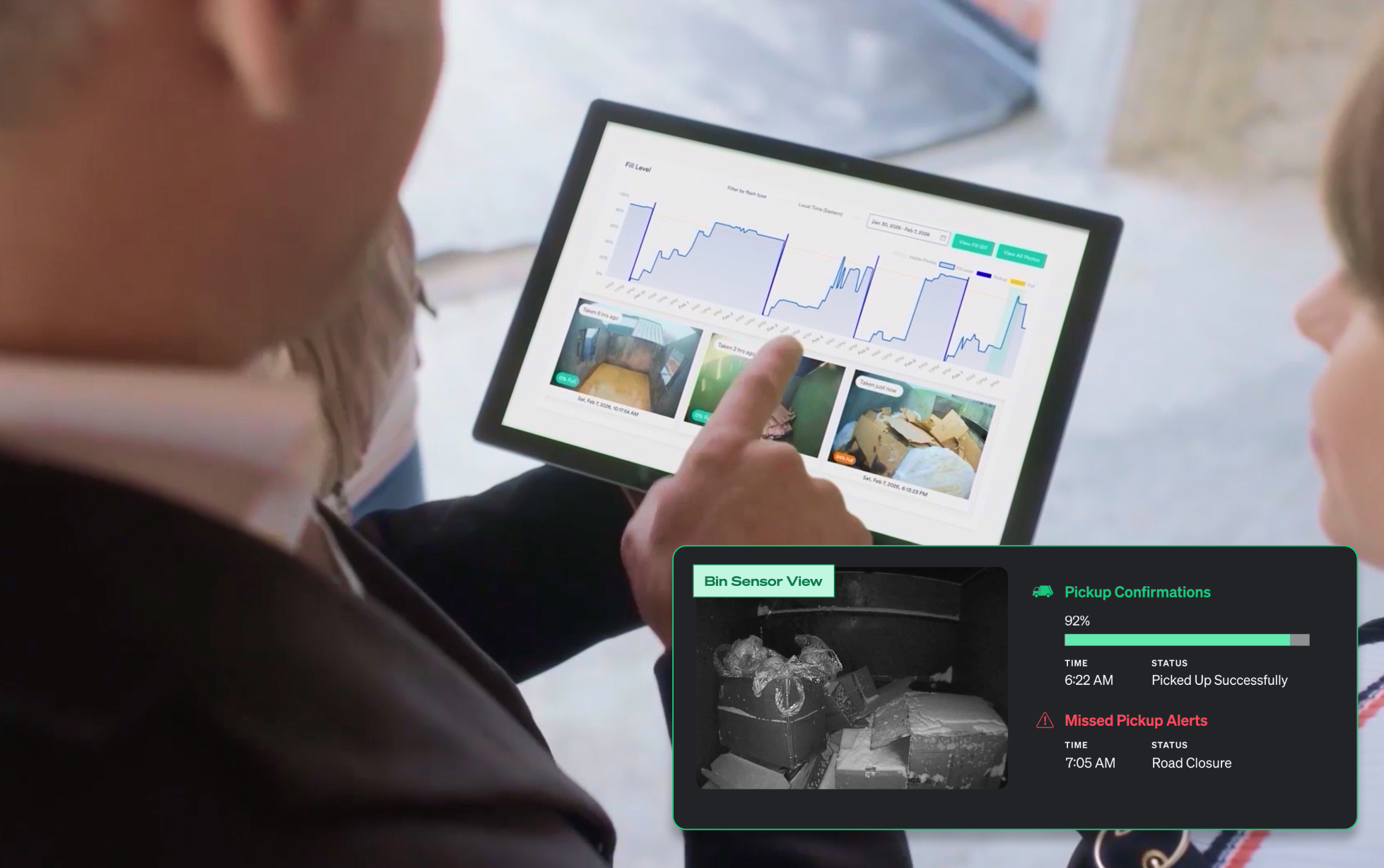
Modern KPI tracking relies on a blend of hardware and software, moving away from estimated weights toward verified data. Common tools include IoT-enabled bin sensors, digital dashboards, and automated reporting systems. Data validation is key; clean data rules ensure that the information used for reporting is accurate, consistent, and free from guesswork.
Digital transformation in waste starts with a waste audit. You cannot set a baseline using only hauler invoices, which often rely on estimated weights.
- IoT Ultrasonic Sensors: Mounted inside containers to provide real-time fill-level data, allowing for on-demand rather than static scheduling.
- AI-Driven Camera Systems: Mounted on haul trucks, at loading docks, or built directly into in-container sensors to identify contamination in real-time. RTS’s Pello sensor, for example, pairs a camera with its ultrasonic fill-level sensor, capturing what’s going into the container alongside how full it is.
- Centralized Dashboards: Aggregate data from multiple haulers into a single Source of Truth for ESG reporting (GRI or SASB standards).
In our experience, the old way of measuring waste—looking at an invoice and assuming every bin was full—is no longer acceptable. Smart sensors can now monitor bin levels in real-time, notifying haulers only when a pickup is needed. At RTS, we advocate for integrated dashboards that pull data directly from hauler portals and weigh-scale tickets to create a single source of truth.
Best Practices For KPI Implementation
Implementing a KPI program requires a strategic approach to avoid vanity metrics. Best practices involve aligning KPIs with business goals, standardizing definitions across all facilities, and fostering ownership among ground teams. Success is found when data leads to cultural change, not just a prettier quarterly report.
Rolling out a new system shouldn’t feel like policing; it should feel like optimizing.
Choosing KPIs That Match Business Goals
If your company has a Zero Waste goal, your primary KPI must be diversion. If your goal is strictly cost reduction, focus on fill levels and service frequency.
Creating Consistent Definitions and Data Rules
Does diversion include waste-to-energy? You must standardize these definitions across your entire portfolio so you are comparing apples to apples.
Sharing KPIs Across Teams and Building Ownership
Share results with custodial and warehouse teams. When people see the scorecard, they become more invested in the outcome.
Setting Targets And Improvement Strategies
Targets should be rooted in historical baselines. By accounting for seasonality and facility-specific constraints, businesses can set realistic goals. Analyzing KPI trends allows managers to identify the root causes of performance dips, implement fixes, and track recovery to ensure long-term success.
Setting a goal to increase recycling by 50% in one month is usually a recipe for failure. Instead, look at the baseline. If your current diversion is 20%, a target of 25% is a measurable, strategic goal. KPIs are also early-warning systems. If Cost per Ton spikes, it might indicate contamination. This is where a waste management consultant becomes invaluable, providing the expertise to interpret these trends.
Conclusion: Key Takeaways For KPI Tracking
Effective waste tracking requires a balanced set of operational, financial, and environmental KPIs measured through digital tools. Businesses must move beyond simple disposal and embrace data-driven resource management. The path forward is clear: start with a core set of metrics, establish reliable data sources, and use those insights to drive quarterly improvements.
The landscape of commercial waste is changing. Stakeholders demand transparency. By mastering your waste KPIs, you aren’t just checking a box; you are discovering efficiencies that save money. Our advice is to start small. Assign ownership of your data, set your baseline, and begin the journey toward a more efficient, sustainable future.
SOURCES
Commercial Waste Management Services. (n.d.). In Recycle Track Systems. Retrieved January 26, 2026, from https://www.rts.com/services
Lakhouit, A. (2025). Revolutionizing urban solid waste management with AI and IoT: A review of smart solutions for waste collection, sorting, and recycling. In Results in Engineering (Vol. 25, p. 104018). Elsevier BV. https://doi.org/10.1016/j.rineng.2025.104018
Mosca, L. (2019). Key Performance Indicators 101 & Why They’re Important. In Forbes. https://www.forbes.com/sites/louismosca/2019/06/18/key-performance-indicators-101-why-theyre-important
OLEM US EPA. (2017). National Overview: Facts and Figures on Materials, Wastes and Recycling. In www.epa.gov. https://www.epa.gov/facts-and-figures-about-materials-waste-and-recycling/national-overview-facts-and-figures-materials
In US EPA. Retrieved January 26, 2026, from https://www.epa.gov/recycle/recycling-economic-information-rei-report
Passarini, F., Vassura, I., Monti, F., Morselli, L., & Villani, B. (2011). Indicators of waste management efficiency related to different territorial conditions. In Waste Management (Vol. 31, Number 4, pp. 785–792). Elsevier BV. https://doi.org/10.1016/j.wasman.2010.11.021
Shih, W. C. (2022). Are the Risks of Global Supply Chains Starting to Outweigh the Rewards? In Harvard Business Review. https://hbr.org/2022/03/are-the-risks-of-global-supply-chains-starting-to-outweigh-the-rewards
Step-by-Step Guide to Plan and Conduct a Waste Audit. (n.d.). In Recycle Track Systems. Retrieved January 26, 2026, from https://www.rts.com/blog/waste-audit-checklist
Waste Management Consultant Services. (n.d.). In Recycle Track Systems. Retrieved January 26, 2026, from https://www.rts.com/services/waste-management-consultant