

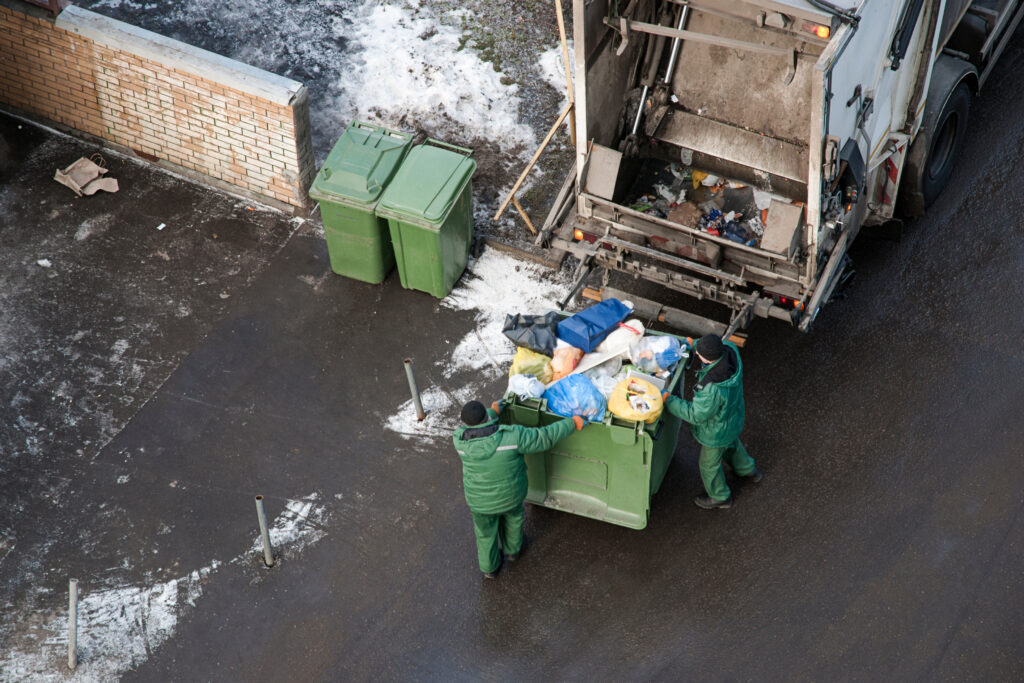
Industrial waste management is a key operational strategy that balances regulatory compliance, cost control, and resource recovery. It requires moving beyond traditional disposal methods toward more data-driven diversion. By optimizing waste handling, you can mitigate risk, lower operating costs and improve ESG performance, turning your industrial by-products into measurable financial and environmental value.
At RTS, we know that in industrial manufacturing – where high volume meets complex regulation – the old way of doing business no longer works. Managing industrial operations requires a progressive approach that transforms waste streams into insight and economic opportunity. This is exactly where we can help at RTS.
Understanding Industrial Waste Management
Industrial waste management encompasses the collection, transport, treatment, recycling, and disposal of materials generated during manufacturing. Unlike commercial waste, industrial by-products present unique regulatory and volume challenges, often due to varied chemical compositions. Managing these streams requires a structured operational framework that prioritizes safety, material recovery, and transparency across all your facilities.
Why Industrial Waste Management Matters
Industrial waste management is a critical function of your business. In our experience, failing to treat waste management as a strategic priority can expose facilities to harsh regulatory penalties, higher hauling fees, and environmental liabilities. On the other hand, a more proactive strategy safeguards local ecosystems, protects staff, and optimizes consumption.
Every day, we challenge the old landfill-dependent model by proving that smarter technology and better habits can move industries toward zero waste. When facilities analyze their waste streams at the operational level, they uncover hidden costs. According to the U.S. Environmental Protection Agency (EPA), industrial facilities in the United States generate around 7.6 billion tons of non-hazardous industrial waste annually (although as much as 97% of this is wastewater). This represents a massive opportunity for material recovery and cost savings.
Types and Classification of Industrial Waste
Accurate waste classification is essential for safety and compliance. Categorization dictates handling, storage, transport, and treatment protocols:
- Hazardous Waste: Toxic, ignitable, corrosive, or reactive materials posing substantial hazards to human health or the environment.
- Non-Hazardous Waste: High-volume by-products such as industrial wastewater sludge, ash, grindings, and non-toxic manufacturing debris.
- Solid and Liquid Waste: Process wastewater, chemical sludges, spent coolants, and solid off-cuts requiring distinct containment.
- Chemical Waste: Spent solvents, reagents, and cleaning compounds subject to strict environmental tracking.
- Scrap Metals and By-Products: Ferrous and non-ferrous metals and off-spec products with commodity resale value.
- Construction and Demolition (C&D) Waste: Concrete, rebar, and structural debris generated during plant maintenance or retrofits.
Navigating Industrial Waste Regulations and Compliance
Regulatory compliance forms the baseline of every successful waste program. Federal, state, and local frameworks govern how waste is identified, stored, transported, and treated. Establishing compliance protocols helps you prevent environmental incidents, avoid severe financial penalties, and protect your brand’s operating license.
Understanding Regulatory Requirements
Compliance requires an in-depth understanding of mandates like the Resource Conservation and Recovery Act (RCRA). Industrial generators are legally responsible for all waste, even after material leaves the site. Your obligations include waste characterization, storage time limits, container labeling, complete shipping manifests, and annual reporting.
Building a Compliant Waste Management Program
To maintain compliance across facilities, you need to embed systematic practices into daily routines:
- Conduct Routine Waste Audits: Evaluate waste streams regularly and identify risks.
- Maintain Accurate Manifests: Utilize digital tracking systems to record every shipment.
- Enforce Storage Standards: Ensure containers are structurally sound, sealed, and labeled.
- Implement Staff Training: Train personnel on safe handling procedures, spill response, and regulatory rules.
- Partner with Vetted Providers: Work exclusively with licensed transporters and disposal facilities.
Reducing Industrial Waste Management Costs
Industrial waste management is a controllable operational expense. By streamlining your production processes, improving material segregation, and capturing resale value from recyclable scrap, it’s possible to lower disposal fees while improving overall efficiency.
Strategies for Lowering Waste Management Costs
We feel waste reduction should start upstream. Minimizing waste generation at the production phase reduces material purchasing costs and eliminates disposal fees. Facilities achieve immediate cost reductions by adopting clean manufacturing practices, right-sizing haul schedules, and segregating high-value recyclables.
Measuring Financial Impact
Measuring financial performance requires tracking your total disposal costs, haul fees, and recycling revenue against production volumes. Calculating these metrics empowers your teams to demonstrate clear ROI on sustainability investments.
Increasing Waste Diversion Through Better Practices
Maximizing waste diversion requires moving away from linear waste models toward closed-loop circular systems. By implementing material recovery, byproduct reuse, and waste-to-energy initiatives, it’s possible to divert waste away from landfills while securing sustainable raw material streams.
Best Practices for Waste Diversion
Achieving high diversion rates requires establishing specialized recovery pathways:
- Material Recovery: Feeding clean scrap metal, plastics, and paper directly back into production cycles or secondary markets.
- By-Product Reuse: Partnering with adjacent industries to turn manufacturing by-products into inputs for secondary products.
- Solvent Recovery: Utilizing distillation or off-site processing to recover and reuse industrial solvents and coolants.
- Composting: Diverting organic process waste and food processing residuals to commercial composting facilities.
- Energy Recovery: Routing non-recyclable, high-BTU waste to permitted waste-to-energy facilities as a secondary fuel source.
Tracking Diversion Performance
We’ve seen how critical waste transparency is to strong ESG performance, which is why we help organizations capture the reporting and data needed to obtain real results. You need to track diversion rates, landfill reduction percentages, container contamination rates, and carbon offsets to benchmark your performance across locations.
Environmental and Community Impacts of Industrial Waste
Industrial facilities are an integral part of local ecosystems. Responsible waste management prevents soil degradation, groundwater contamination, and air pollution, and crucially establishes trust with regulators, neighbors, and corporate stakeholders.
Improperly handled industrial waste can have potentially disastrous ecological consequences. Chemical leaks and unlined landfill disposal can leach heavy metals and synthetic compounds into the earth and waterways. Prioritizing zero-waste initiatives conserves natural resources and eliminates greenhouse gas emissions associated with landfill decomposition. It also builds positive relationships and supports corporate ESG goals.
Technology Improving Industrial Waste Management
Modern technology is transforming industrial waste management into an automated and data-rich operational function. Advanced software platforms, IoT sensors, and analytics provide real-time visibility into your waste streams, optimizing logistics, reducing costs, and simplifying reporting.
Here at RTS, we leverage technology to give facilities greater control over material streams. Deploying IoT fill-level sensors inside compactors prevents costly emergency hauls. Meanwhile, an integrated waste management portal provides real-time tracking, automated reporting, and verified weight data, allowing you to optimize operations.
Expert Guidance for Building a Long-Term Strategy
Building a resilient waste strategy requires a commitment to improvement, staff education, and strategic partnership. Moving beyond basic compliance allows you to future-proof operations against rising disposal costs.
To construct a robust long-term framework, you should follow a structured roadmap:
- Conduct Site Audits: Perform detailed physical waste characterizations across all production lines.
- Establish Benchmarks: Set realistic, measurable waste reduction targets tailored to plant capabilities.
- Invest in Workforce Training: Educate personnel on material sorting, safety protocols, and waste reduction goals.
- Partner with Specialists: Deploy customized industrial waste solutions designed to streamline logistics and maximize diversion.
- Review Strategy Annually: Audit metrics, evaluate emerging technologies, and adapt processes to changing market conditions.
Conclusion
Industrial waste management is a driver of operational efficiency, cost reduction, and environmental stewardship. By embracing data-driven recovery, you can ensure regulatory compliance, lower operating expenses, and a reduced environmental footprint.
We started RTS to build a world without waste, and we know that achieving this future requires partnering with forward-thinking leaders across the industrial sector. Contact our team today to learn how our technology and expertise can transform your facility’s waste program.
FAQs
Q1. How long can hazardous waste be stored on-site before disposal?
Under RCRA guidelines, storage limits depend on generator status. Very Small Quantity Generators (VSQGs) have no set time limit until reaching specific weight thresholds, Small Quantity Generators (SQGs) can store waste on-site for up to 180 days, and Large Quantity Generators (LQGs) are restricted to 90 days without a permit.
Q2. What are penalties for improper industrial waste disposal?
Penalties for RCRA non-compliance can exceed $50,000 per violation per day, alongside potential criminal liability, civil lawsuits, facility shutdown orders, and severe brand damage.
Q3. Do industrial facilities get tax incentives for waste reduction investments?
Yes, many state and federal programs offer tax credits, grants, and accelerated depreciation deductions for facilities investing in pollution prevention equipment and recycling infrastructure.
Q4. How often should industrial waste audits be conducted?
Facilities should conduct comprehensive physical waste audits annually, supplemented by quarterly digital reviews of hauler manifests, weight tickets, and diversion metrics.
Q5. Can hazardous waste ever be reclassified as non-hazardous?
Yes, under specific RCRA provisions, certain hazardous wastes can be reclassified or “delisted” if a generator proves that the waste stream no longer exhibits hazardous characteristics.
SOURCES
California Department of Toxic Substances Control. (n.d.-a). Regulations. https://dtsc.ca.gov/regs/
California Department of Toxic Substances Control. (n.d.-b). Waste classification. https://dtsc.ca.gov/waste-classification/
Recycle Track Systems. (n.d.-a). Industrial & logistics waste management services. https://www.rts.com/sector/industrial-logistics/
Recycle Track Systems. (n.d.-b). RTS portal. https://www.rts.com/product/portal/
Recycle Track Systems. (2020, March 18). What is a smart waste bin? https://www.rts.com/blog/what-is-a-smart-waste-bin/
Central Queensland University. (2021). What is industrial solid waste? FutureLearn. https://www.futurelearn.com/info/courses/introduction-to-environmental-science/0/steps/271555
Recycle Track Systems. (2022, November 15). Waste compliance for business. https://www.rts.com/blog/waste-compliance-for-business/
Recycled Materials Association. (n.d.). Tax & advocacy compliance. https://www.recycledmaterials.org/advocacy-compliance/tax/
U.S. Environmental Protection Agency. (n.d.-a). Instructions for conducting waste assessments. https://www.epa.gov/smm/instructions-conducting-waste-assessments
U.S. Environmental Protection Agency. (n.d.-b). Resource Conservation and Recovery Act (RCRA) regulations. https://www.epa.gov/rcra/resource-conservation-and-recovery-act-rcra-regulations
U.S. Environmental Protection Agency. (n.d.-c). Summary of the Resource Conservation and Recovery Act. https://www.epa.gov/laws-regulations/summary-resource-conservation-and-recovery-act
U.S. Environmental Protection Agency. (n.d.-d). What is a circular economy? https://www.epa.gov/circulareconomy/what-circular-economy
U.S. Environmental Protection Agency. (1998). Guide for industrial waste management (EPA 530-R-98-010). https://www.epa.gov/sites/default/files/2016-03/documents/industrial-waste-guide.pdf
U.S. Environmental Protection Agency. (2020). Factsheet: Requirements for Very Small Quantity Generators of hazardous waste (EPA 530-F-20-002). https://www.epa.gov/hwgenerators/fact-sheet-requirements-very-small-quantity-generators-hazardous-waste
Carbon Market Watch. (n.d.). Carbon credit. https://carbonmarketwatch.org/glossary/carbon-credit/
De Silva, S., Carson, P., Indrapala, D. V., Warwick, B., & Reichman, S. M. (2023). Land application of industrial wastes: Impacts on soil quality, biota, and human health. Environmental Science and Pollution Research, 30(25), 67974–67996. https://doi.org/10.1007/s11356-023-26893-7