

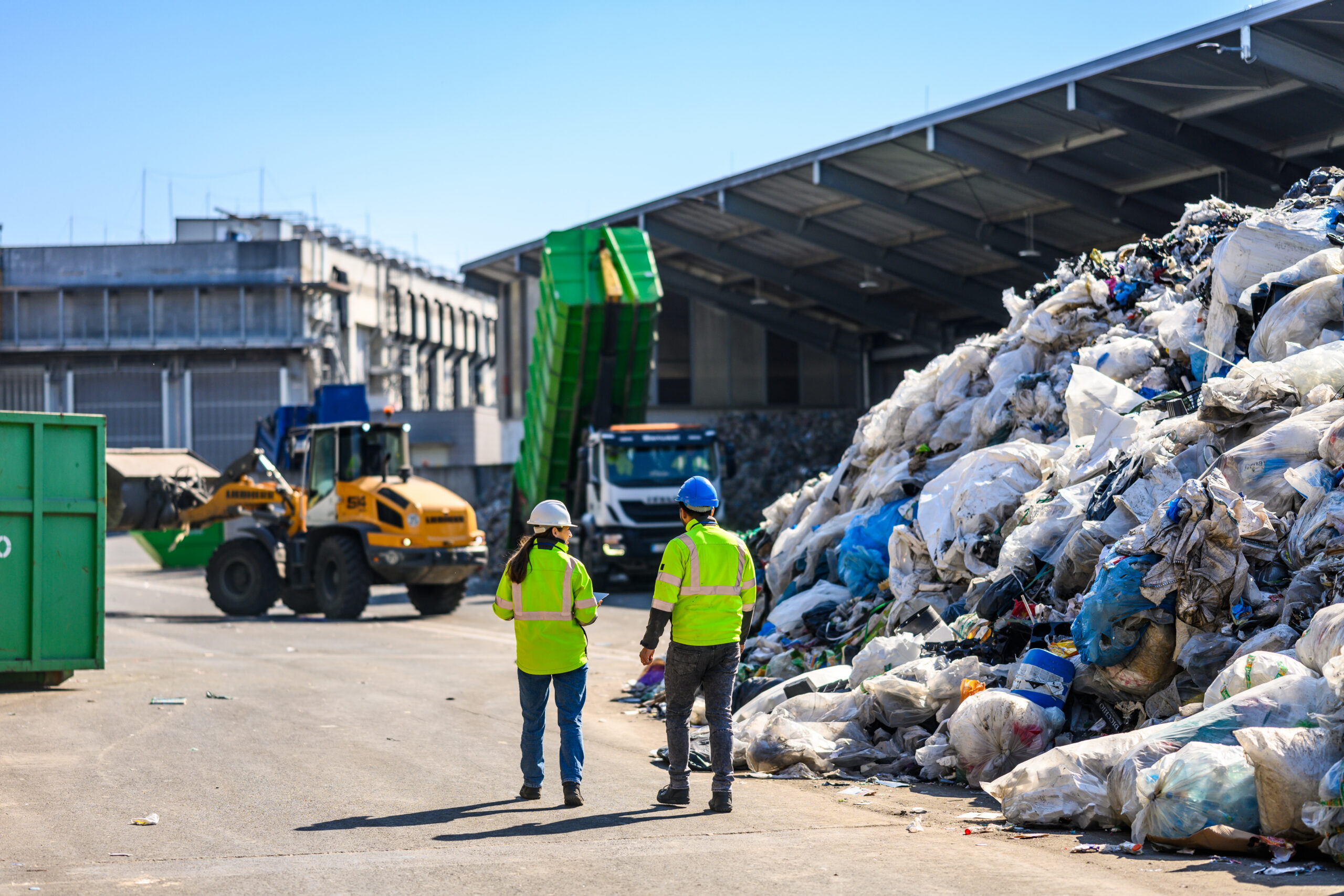
In the last couple of years, achieving zero waste to landfill has shifted from a sustainability target to an urgent corporate requirement. As disposal fees become unpredictable and regulations get stricter, eliminating our dependency on landfills is a must for operational efficiency. However, by reorganizing supply chains, using advanced data tracking, and optimizing resource recovery, it is now possible to reduce your impact while building financial and reputational value.
We started RTS because we felt that the waste industry could do better. We also knew that businesses wanted and needed a partner committed to real sustainability. For decades, traditional waste management worked on a “take-make-dispose” model. Today, we are helping corporate leaders and sustainability directors disrupt that cycle to take advantage of the economic and environmental opportunities of a circular economy.
What Does Zero Waste to Landfill Actually Mean?
Zero waste to landfill means diverting a vast majority of operational waste away from municipal landfills through the reduction, reuse, recycling, composting, and recovery of materials. While the definition implies elimination, major global standard-setters and third-party certification bodies define it by diversion thresholds. Understanding these specific benchmarks is essential for public reporting and compliance measures.
In our experience, understanding the definition is vital before developing your corporate waste strategy. A true zero waste philosophy focuses on redesign, aiming to eliminate the concept of waste entirely by keeping resources within a circular production cycle. Conversely, zero waste to landfill focuses heavily on the end-of-life phase.
The most recognized validation frameworks set the bar at 90%. UL 2799, the Standard for Environmental Claim Validation Procedure for Zero Waste to Landfill, requires at least 90% diversion through methods other than waste-to-energy, with Silver, Gold, and Platinum designations awarded as rates climb toward 100%. TRUE certification, administered by GBCI, likewise requires 90% or greater diversion from landfill, incineration, and the environment. Here at RTS, we know that meeting these thresholds requires differentiating between standard diversion practices and advanced resource recovery.
Why Zero Waste to Landfill Is Becoming a Business Priority
Modern businesses face mounting pressure from investors, regulators, and consumers to prove environmental responsibility. Linear waste management exposes companies to volatile landfill fees and regulatory fines. However, implementing a zero waste to landfill strategy mitigates these financial risks, meets stringent ESG reporting standards, optimizes supply chain costs, and can even boost your brand equity.
The way landfills work is environmentally disastrous, with municipal solid waste landfills representing the third-largest source of human-related methane emissions in the United States, according to the EPA.
In addition, landfill costs continue to climb globally as urban space declines. Relying on dumping is an operational risk. That’s why we’ve watched clients shift their mindset from “waste as a cost” to “waste as an opportunity,” realizing that every ton of material diverted from a landfill represents recovered value and protected margins.
The Step-by-Step Roadmap to Zero Waste to Landfill
Moving toward zero waste requires a structured, data-driven approach that is aligned with internal operations, as well as external vendors. It’s a journey that requires changing your behavior, as well as ongoing technological tracking. This can then provide a framework to systematically phase out the reliance on landfill across your commercial facilities.
Step 1: Conduct a Waste Audit and Establish a Baseline
You can’t manage what you don’t measure, as we say at RTS. A comprehensive physical waste audit involves sorting, weighing, and categorizing your waste streams over a set period. This establishes your baseline generation volume and highlights exactly what recyclable or organic materials are being incorrectly discarded.
Step 2: Apply the Waste Hierarchy
Prioritize actions based on impact. Reduction and reuse sit at the top of the hierarchy. Take a closer look at your procurement to eliminate single-use packaging at source, then optimize recycling and composting streams for other materials.
Step 3: Tackle Hard-to-Divert Waste Streams
Every facility has complex waste items that municipal haulers won’t accept. Partnering with a specialized waste management consultant helps identify suitable processing facilities or take-back programs.
Step 4: Engage Employees at Every Level
Corporate initiatives often fail without buy-in. Build ‘green teams’ and implement clear, color-coded signage at disposal stations, as well as run training sessions. Eliminating contamination at the bin level is crucial for maintaining the market value of your recyclables.
Step 5: Use Technology and Data to Track Progress
Modern resource management relies heavily on digital tracking. Implementing internet-of-things (IoT) infrastructure, such as smart bin sensors, gives real-time transparency into fill levels and pickup frequencies, enabling optimization and more accurate diversion accounting.
Step 6: Verify, Document, and Certify
To safeguard your brand against greenwashing allegations, you need to validate your achievements through third-party audits. Documenting your metrics provides the verified data you need for corporate sustainability reports.
Benefits of Zero Waste to Landfill
Organizations that successfully eliminate landfill waste can benefit from immediate competitive advantages. Beyond just lowering hauling and disposal expenditures, zero-waste initiatives provide data points that strengthen your reporting. These initiatives protect operations from environmental taxes, attract top-tier talent, and uncover supply chain inefficiencies.
We’ve seen how critical waste transparency is to strong ESG performance, which is why we help organizations capture the data, report, and measure their impact in order to turn sustainability goals into real results. According to the World Bank, global waste generation is projected to grow by 70% by 2050, making resource conservation a major economic necessity. By recovering valuable commodities like metals, clean fiber, and organics, businesses can protect themselves from raw material price fluctuations while simultaneously building a more circular future.
Common Challenges and How to Overcome Them
The path to zero waste is often obstructed by structural and behavioral challenges, including contamination, fragmented infrastructure, and low employee engagement. However, these challenges can be solved through targeted technological interventions and training.
| Challenge | Strategic Solution |
| High Contamination Rates | Deploy clear signage at the point of disposal and conduct regular spot-checks. |
| Infrastructure Deficits | Work with a waste management consultant to tap into national secondary material markets. |
| Inconsistent Tracking | Retrofit collection containers with smart bin sensors to automate volume tracking. |
| Hard-to-Divert Materials | Establish mail-back or vendor take-back programs to bypass municipal limitations. |
How RTS Can Help You Achieve Zero Waste to Landfill
RTS can help by transforming your physical waste into actionable data and an environmental opportunity. We partner with organizations across all major commercial sectors to design, execute, and scale custom diversion programs. Through digital tracking, dedicated material routing, and independent auditing, we help you to phase out your landfill dependency.
Every day, we challenge the old landfill-dependent model by proving that smarter technology and better habits can move organizations toward sustainability. We provide on-site waste studies, source-separated recycling logistics, and comprehensive data platforms that record your carbon mitigation metrics. We equip your C-suite and facility managers with the transparency required to optimize resources, satisfy compliance, and drive sustainability. Get in touch with our team to find out more.
Frequently Asked Questions
What percentage counts as zero waste to landfill?
The leading standards, UL 2799 and TRUE, both require a minimum 90% diversion rate of operational waste from landfills and incineration to qualify. Under UL 2799, 90–94% diversion earns Silver, 95–99% earns Gold, and 100% earns Platinum designation.
Is zero waste to landfill the same as zero waste?
No. Zero waste to landfill focuses on diverting downstream outputs through recycling, composting, or recovery. A true zero waste approach focuses on upstream systemic redesign to eliminate waste creation.
How long does it take to achieve zero waste to landfill?
Small to mid-sized businesses typically establish stable diversion pathways within 6 to 12 months, while large commercial enterprises or complex manufacturing facilities may require a phased 2 to 4-year transition.
Does waste-to-energy count toward zero waste to landfill?
In some cases, yes. Many certification bodies accept waste-to-energy for residual, non-recyclable materials. However, it sits lower on the environmental hierarchy than source reduction, reuse, and recycling.
Sources
Plan A. (n.d.). What is ESG performance and how to improve it? Plan A Academy. https://plana.earth/academy/esg-performance
Recycle Track Systems. (n.d.-a). Guide to True Zero Waste certification. https://www.rts.com/resources/guides/guide-to-true-zero-waste-certification/
Recycle Track Systems. (n.d.-b). How landfills work and why they must be phased out. https://www.rts.com/blog/how-landfills-work-and-why-they-must-be-phased-out/
Recycle Track Systems. (n.d.-c). Pello smart bin sensors. https://www.rts.com/pello-smart-bin-sensors/
Recycle Track Systems. (n.d.-d). Waste management consultant. https://www.rts.com/services/waste-management-consultant/
UL Solutions. (n.d.). UL Solutions. https://www.ul.com/
United Nations. (n.d.). Greenwashing: The deceptive tactics behind “eco-friendly” claims. https://www.un.org/en/climatechange/science/climate-issues/greenwashing
U.S. Environmental Protection Agency. (n.d.). Environmental Protection Agency. https://www.epa.gov/
U.S. Environmental Protection Agency. (n.d.). Basic information about landfill gas. Landfill Methane Outreach Program (LMOP). https://www.epa.gov/lmop/basic-information-about-landfill-gas
Waste Business Journal. (2024, June 3). Waste Industry News update. https://www.wasteinfo.com/news/wbj20240603A.htm
World Bank. (2018, September 20). Global waste to grow by 70 percent by 2050 unless urgent action is taken: World Bank report [Press release]. https://www.worldbank.org/en/news/press-release/2018/09/20/global-waste-to-grow-by-70-percent-by-2050-unless-urgent-action-is-taken-world-bank-report
Zero Waste International Alliance. (n.d.-a). Zero Waste International Alliance. https://zwia.org/
Zero Waste International Alliance. (n.d.-b). Zero landfill is not zero waste. https://zwia.org/zero-landfill-is-not-zero-waste/