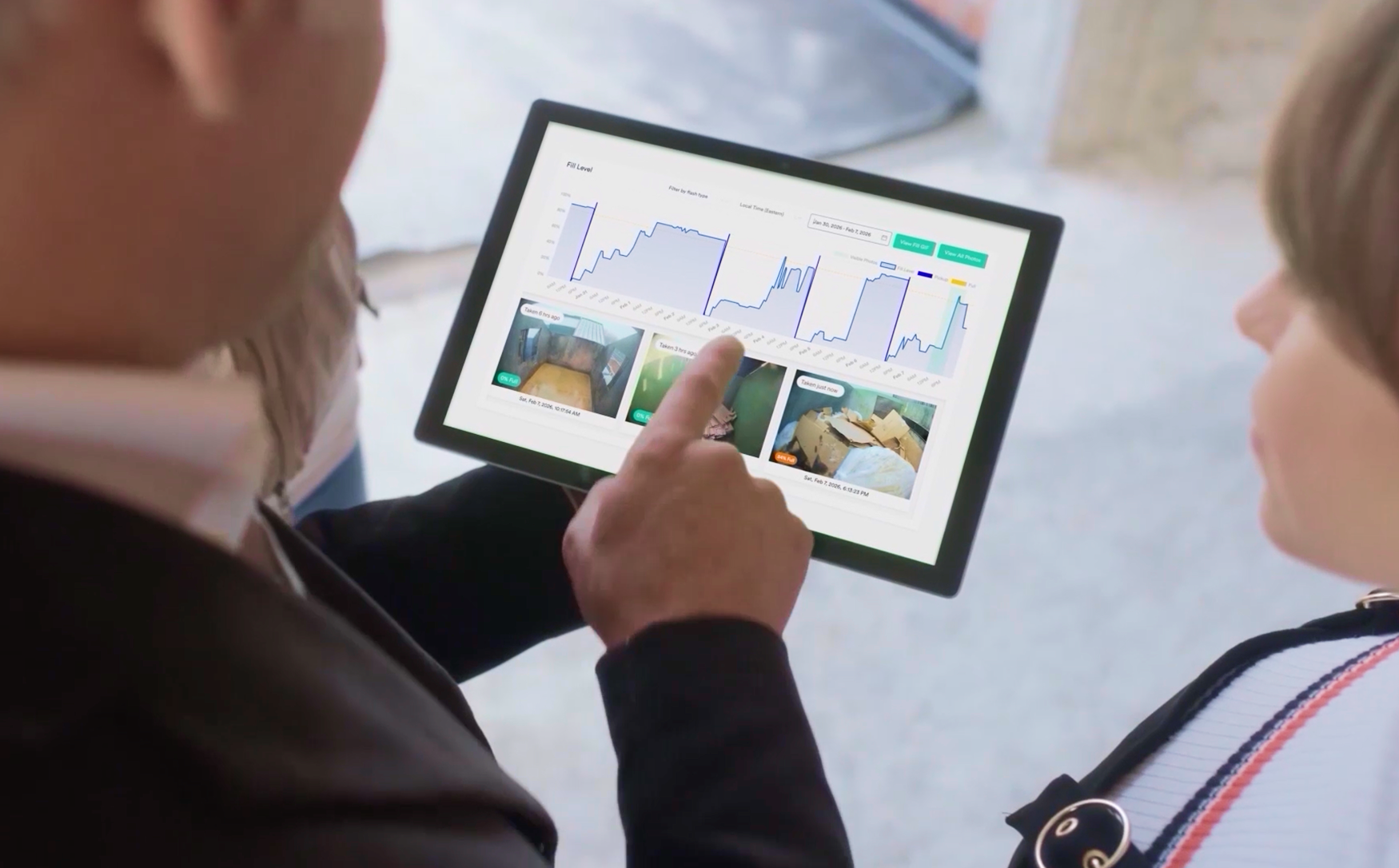
Artificial Intelligence is a vital tool for modern businesses striving for sustainability. By integrating AI, companies move beyond the “guesswork” of traditional waste management. We explore how AI-driven sorting, predictive analytics, and smart sensors solve historical inefficiencies, help businesses meet strict ESG waste management goals, and turn waste management from a hidden cost into a strategic, data-rich asset.
For decades, waste management was considered an out of sight, out of mind utility. Today, the climate crisis and rising costs demand a more sophisticated approach. Businesses are no longer satisfied with simple disposal—they want recovery and transparency.
Current trends show the scale of the problem, with many businesses facing significant inefficiencies in waste handling, often paying to haul air in half-empty bins. That’s why, here at RTS, we feel that the marriage of waste management technology and AI is the single most important advancement for the circular economy today. AI-driven predictive analytics can forecast waste generation trends, enabling businesses to proactively manage waste reduction strategies. By utilizing advanced technologies like IoT sensors, AI analytics, and blockchain, organizations can collect and verify real-time data on waste production, disposal, and recycling efforts.
The Challenges of Traditional Waste Management
Traditional waste management relies on static schedules and manual sorting, leading to environmental and financial inefficiencies. Without real-time data, trucks take unnecessary routes and increase emissions, while human error leads to high contamination. These inefficiencies, combined with tightening regulations and rising taxes, make the old model unsustainable for any growth-focused business.
In our experience, conventional models are inherently reactive. You don’t know a bin is overflowing until a tenant complains, and you don’t know your recycling is contaminated until you receive a fine. Some of the challenges are as follows:
Inefficiencies in Collection and Disposal
Standard contracts dictate pickups regardless of whether the bin is 10% or 100% full. This “hauling air” wastes fuel and money. Here at RTS, we know these ghost pickups contribute significantly to unnecessary CO2 emissions.
Environmental Impact of Improper Waste Handling
When recyclables mix with organic waste, the load often ends up in a landfill. This contributes to methane production—a gas far more potent than CO2. According to the EPA, food waste alone is responsible for approximately 58% of landfill methane emissions.
Rising Costs and Regulatory Pressures
From organic waste bans in states like California and New York to increasing levies, the legal landscape is changing. Traditional methods cannot provide the audit trails needed to prove compliance. Businesses are finding that “the old way” is becoming an expensive legal liability.
How AI is Transforming Waste Management
AI revolutionizes the industry by introducing vision and intelligence to hardware. AI-powered robots sort recyclables with speed and accuracy exceeding human capability, while predictive analytics optimize hauling routes. By utilizing smart sensors and IoT monitoring, businesses transition to a demand-driven model, drastically reducing the carbon footprint of waste logistics.
The shift from manual to digital is profound. In our experience, when a business gains a clearer digital view of its waste stream, improvement opportunities become obvious.
AI-Powered Sorting and Recycling Technologies
Modern Materials Recovery Facilities (MRFs) now employ AI-driven robotic arms. These systems use computer vision to identify plastics, metals, and paper, even when soiled. Robots can perform up to 80 picks per minute—double what a human can manage—ensuring higher purity. The element of Artificial Intelligence that is most relevant to AI in waste management is ‘visual perception’. AI is able to reduce contamination by sorting and separating waste more consistently, and is able to do so at a lower cost.
Predictive Analytics for Waste Collection
AI analyzes historical data and local events to predict when a building will reach capacity. This allows for dynamic routing—trucks only go where they are needed, taking the most fuel-efficient path.
Smart Sensors and IoT in Waste Monitoring
The use of smart bin sensors is a game-changer. These ultrasonic devices measure fill levels in real-time. When integrated with an AI platform, they alert a waste management consultant or hauler exactly when a pickup is required, preventing overflows and unnecessary trips.
Business Benefits of AI Waste Management Systems
AI-driven systems offer cost savings, sustainability, and data transparency. By eliminating unnecessary pickups and reducing fines, businesses see immediate bottom-line improvements. Furthermore, granular data allows companies to report accurately on ESG progress, providing a competitive edge in a market where investors prioritize environmental responsibility.
Cost Reduction and Operational Efficiency
Stopping pickups you don’t need saves money quickly, delivering a huge reduction in hauling costs through sensor-based, AI-optimized schedules.
Meeting Sustainability Goals and ESG Requirements
ESG reporting is now a requirement for many organizations. AI provides a Chain of Custody for waste. You can prove exactly how many tons were diverted, backed by digital weigh-tickets and sensor data, avoiding greenwashing accusations.
Data-Driven Decision Making and Reporting
As a waste management consultant might tell you, you cannot manage what you do not measure. AI dashboards show which facilities recycle correctly and which need training, allowing for targeted interventions.
Implementation Challenges and Considerations
Implementation requires a strategic approach. Businesses must navigate initial investments, ensure integration with existing infrastructure, and manage staff training. A successful rollout is less about the “gadgets” and more about creating a culture that values data-driven environmental stewardship.
In our experience, technology is the easy part; change management is where the work happens.
- Initial Investment: While there is an upfront cost for waste management technology, most businesses see ROI within 12 to 18 months through reduced fees.
- Integration: Your AI platform must communicate with your hauler’s dispatch. We advocate for open platforms that bridge gaps between service providers.
- Training: An AI sorter is only as good as the stream it receives. Educating custodial teams and workers on new bin configurations is key to success.
The Future of AI in Sustainable Waste Management
We are moving toward a Circular Economy 2.0, where AI analyzes consumption patterns to prevent waste before it happens. Innovations like autonomous electric garbage trucks and AI-driven waste-to-product matching will further close the loop, making zero-waste a reachable goal for businesses.
In our experience, the next decade will see waste management become almost entirely automated.
- Digital Twins: Modeling a campus’s waste flow in a virtual environment to test what-if scenarios.
- Closing the Loop: AI provides the tracking and sorting capabilities required to turn discarded materials back into valuable resources repeatedly.
Conclusion: Adopting AI for a Greener Future
AI in waste management is a milestone for sustainable business. By solving past inefficiencies and providing future data, AI empowers companies to act against climate change while protecting margins. The tools—from smart bin sensors to predictive analytics—are ready. The question is how quickly you can adopt them.
Explore RTS AI solutions to make your waste management smarter and greener. Pello is technology that offers a real-time monitoring system for waste management. By providing instant updates and notifications on a user-friendly dashboard, Pello enables users to efficiently track bin capacity, address waste requirements, and prevent overflow, contamination, and unnecessary expenses.
With the help of Imaging AI and accurate fullness data, Pello achieves over 95% accuracy in identifying pickups, resulting in operational efficiencies, cost savings, timely payments, and a reduction in greenhouse gas emissions by eliminating unnecessary hauls.
Sources:
Analysis. (n.d.). CO₂ emissions. International Energy Agency. Retrieved January 26, 2026, from https://www.iea.org/reports/global-energy-review-2025/co2-emissions
Cisco. (n.d.). Recycling robots debut in Florida. Retrieved January 26, 2026, from https://newsroom.cisco.com/c/r/newsroom/en/us/a/y2019/m11/recycling-robots-debut-in-florida.html
Hoover, D. (2025). How state organic waste ban policies can drive food waste reduction. Natural Resources Defense Council. https://www.nrdc.org/bio/darby-hoover/how-state-organic-waste-ban-policies-can-drive-food-waste-reduction
Recycle Track Systems. (n.d.). 6 smart waste management technologies emerging in 2026. Retrieved January 26, 2026, from https://www.rts.com/blog/smart-waste-management-technologies
Recycle Track Systems. (n.d.). How to achieve ESG goals with smart waste management. Retrieved January 26, 2026, from https://www.rts.com/blog/esg-waste-management
Recycle Track Systems. (n.d.). Pello smart bin sensors: Waste fill-level tracking. Retrieved January 26, 2026, from https://www.rts.com/pello-smart-bin-sensors
Recycle Track Systems. (n.d.). Waste management consultant services. Retrieved January 26, 2026, from https://www.rts.com/services/waste-management-consultant
ThoughtSpot. (n.d.). What are AI dashboards? A 2025 enterprise guide. Retrieved January 26, 2026, from https://www.thoughtspot.com/data-trends/dashboard/ai-dashboard
U.S. Environmental Protection Agency, Office of Research and Development. (2023). Quantifying methane emissions from landfilled food waste. https://www.epa.gov/land-research/quantifying-methane-emissions-landfilled-food-waste